The Ottawa Ankle Rules (OAR) are a set of clinical decision rules used after an acute ankle or midfoot injury to decide who needs X-rays to look for a fracture. Their goal is to reduce unnecessary radiographs while maintaining a very low miss rate for clinically important fractures. Spital Mures+1
When to use them
OAR are intended for acute blunt trauma to the ankle/midfoot in examinable patients. Many protocols restrict use to adults and exclude patients who can’t be reliably assessed (for example due to intoxication or head injury). One guideline also excluded <18 years, pregnancy, multiple painful injuries, and neurologic sensory deficits, and excluded injuries >10 days old. Spital Mures+1
The rules (what triggers imaging)
1) Ankle X-ray series
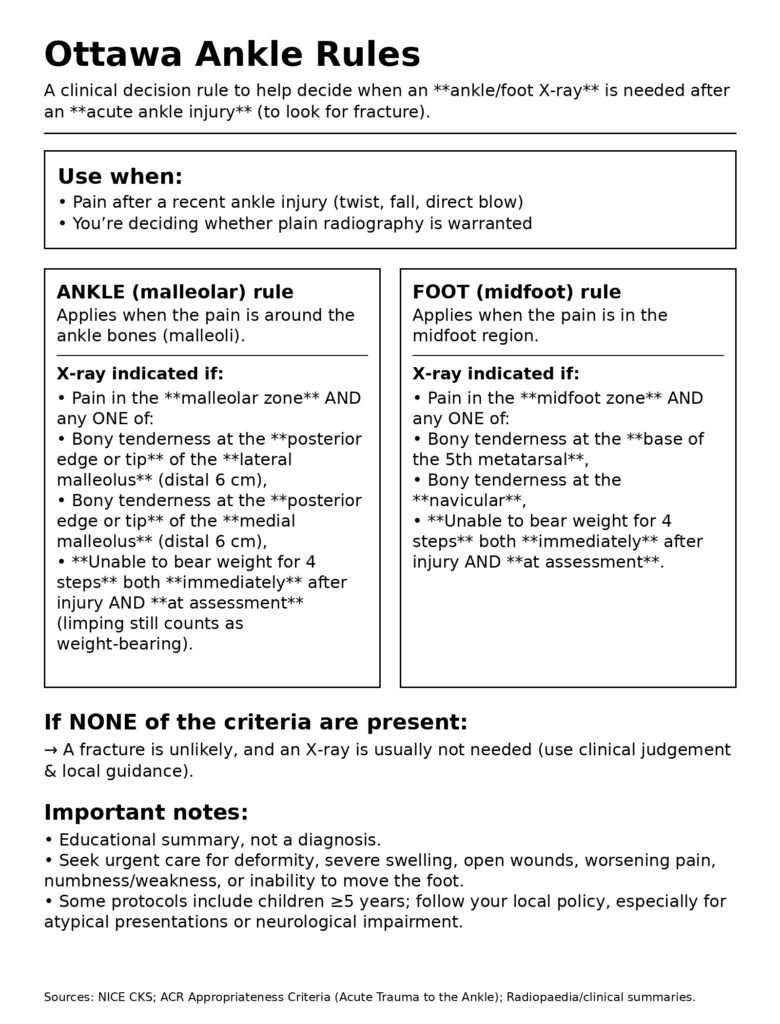
Order ankle radiographs only if there is pain in the malleolar zone and any one of the following: Spital Mures+1
- Bone tenderness along the distal 6 cm of the posterior edge of the fibula or tip of the lateral malleolus, or Spital Mures+1
- Bone tenderness along the distal 6 cm of the posterior edge of the tibia or tip of the medial malleolus, or Spital Mures+1
- Inability to bear weight for 4 steps both immediately and in the emergency department/clinic Spital Mures+1
2) Foot (midfoot) X-ray series
Order foot radiographs only if there is pain in the midfoot zone and any one of the following: Spital Mures+1
- Bone tenderness at the base of the 5th metatarsal, or Spital Mures+1
- Bone tenderness at the navicular, or Spital Mures+1
- Inability to bear weight for 4 steps both immediately and in the emergency department/clinic Spital Mures+1
How accurate are the Ottawa Ankle Rules?
Evidence consistently shows very high sensitivity (good for ruling out fractures when criteria are negative) but only modest/low specificity (so some patients will still be imaged). A large systematic review/meta-analysis reported pooled sensitivity ~99.4% (with specificity ~35%) for the ankle rules. PubMed
Another adult-focused systematic review/meta-analysis reported sensitivity ~0.91 and specificity ~0.25, highlighting variability between studies and settings. PubMed+1
OAR support decision-making, but don’t replace clinical judgment—especially in patients with abnormal neurovascular exam, deformity, severe swelling, open injury, or unreliable history/exam.