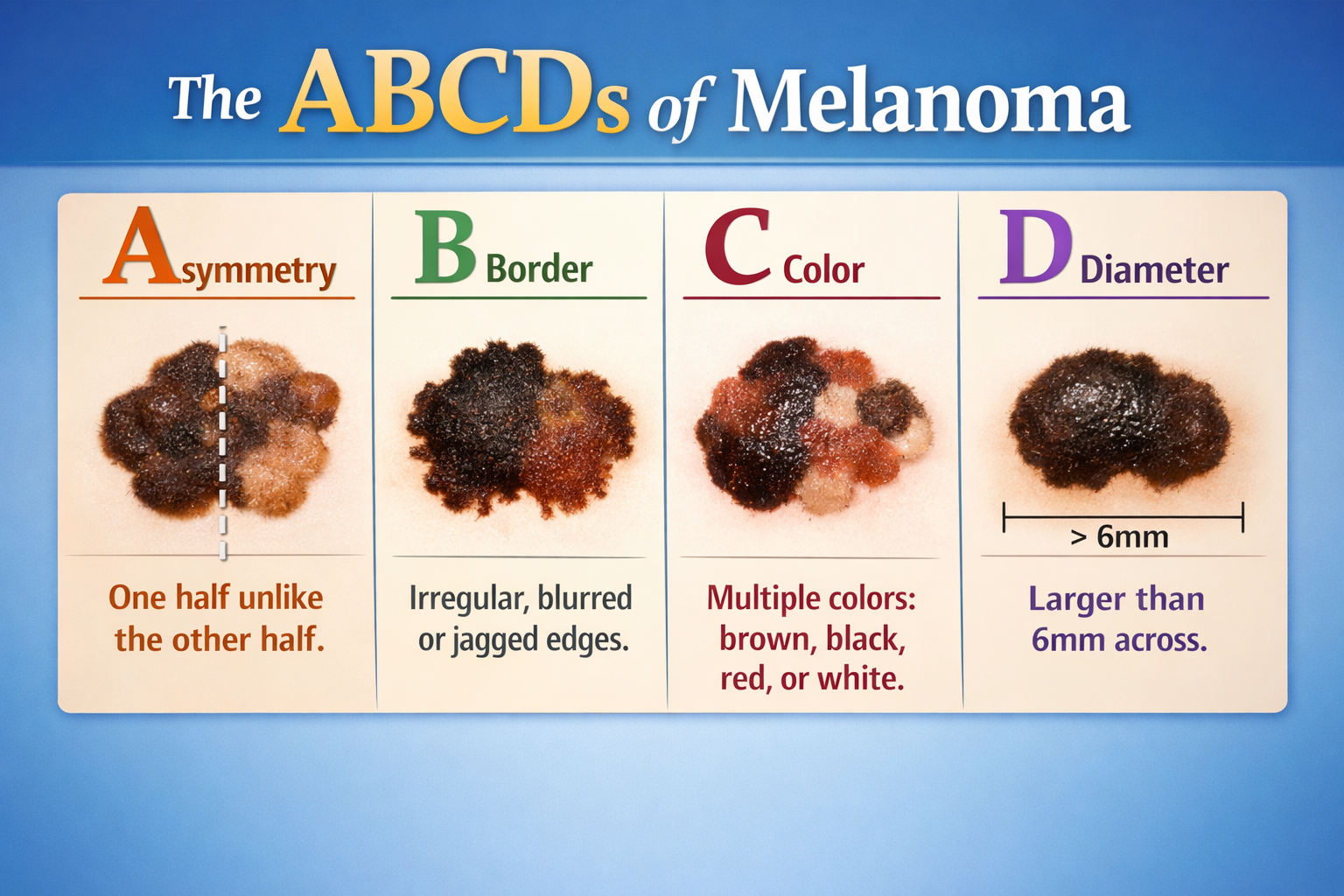
Melanoma is a type of skin cancer that can sometimes look like an ordinary mole—especially early on. The good news is that melanoma is often more treatable when found early, which is why learning a quick self-check method matters. One of the most widely used memory tools is the ABCD rule, which highlights four common warning signs you can look for on moles or dark spots.
Think of the ABCDs as a screening clue, not a diagnosis. If something looks suspicious—especially if it’s new or changing—it’s smart to get it checked by a healthcare professional.
A — Asymmetry
What it means: One half of the spot doesn’t match the other half.
What to look for:
- Imagine drawing a line through the middle of a mole.
- If the two halves look different in shape or thickness, that’s asymmetry.
Why it can matter: Many harmless moles are fairly symmetrical, while melanomas are more likely to have uneven growth patterns.
B — Border
What it means: The edges are uneven instead of smooth.
What to look for:
- Jagged, notched, scalloped, or blurry-looking edges
- Borders that fade into the surrounding skin instead of having a clear outline
Why it can matter: Melanoma may grow in a way that makes the edges look irregular or “messy.”
C — Color
What it means: The spot has more than one color, or the color isn’t typical.
What to look for:
- Multiple shades in one lesion (like brown, black, tan, red, white, blue, or gray)
- Uneven patches of color rather than one consistent tone
Why it can matter: Mixed or changing colors can be a warning sign because melanomas can develop uneven pigment.
D — Diameter
What it means: The spot is larger than what’s typical for a harmless mole.
What to look for:
- Often taught as larger than about 6 mm (around the width of a pencil eraser)
- But smaller spots can still be concerning if they look unusual
Why it can matter: Many melanomas are found after they’ve grown, but size alone isn’t the only factor—appearance and change matter too.
Don’t Forget “E” (Extra Helpful): Evolving
Even though you asked for ABCDs, you’ll often see doctors include a bonus letter:
E — Evolving: Any change in size, shape, color, thickness, or symptoms (like itching or bleeding).
If a mole is changing noticeably over weeks or months, it deserves attention.
How to Use the ABCDs in a Monthly Skin Check
A simple routine:
- Check your skin in good lighting with a mirror (use a hand mirror for hard-to-see areas).
- Compare moles to older photos if you have them.
- Look for ABCD features, and also anything new or changing.
- If something stands out, don’t panic—just book a professional skin exam.
When to See a Doctor
Make an appointment if you notice:
- Any ABCD warning sign
- A spot that’s clearly evolving
- A “different-looking” mole compared to your others (sometimes called the “ugly duckling” sign)
Quick Takeaway
The ABCDs help you spot patterns that are more common in melanoma:
- A: Asymmetry
- B: Border irregularity
- C: Color variation
- D: Diameter (often > 6 mm)